
In an era where patient safety and regulatory compliance are more critical than ever, staying informed about global pharmacovigilance trends is essential. The Saudi Arabia Drug Authority (SFDA) recently released its 2025 Mid-Year Pharmacovigilance Inspection Report, offering a detailed look at inspection outcomes, key findings and areas for improvement.
Our experts break down the highlights of the report to help Marketing Authorization Holders (MAHs) and PV professionals understand what’s working and what needs attention.
What prompted this mid-year inspection report?
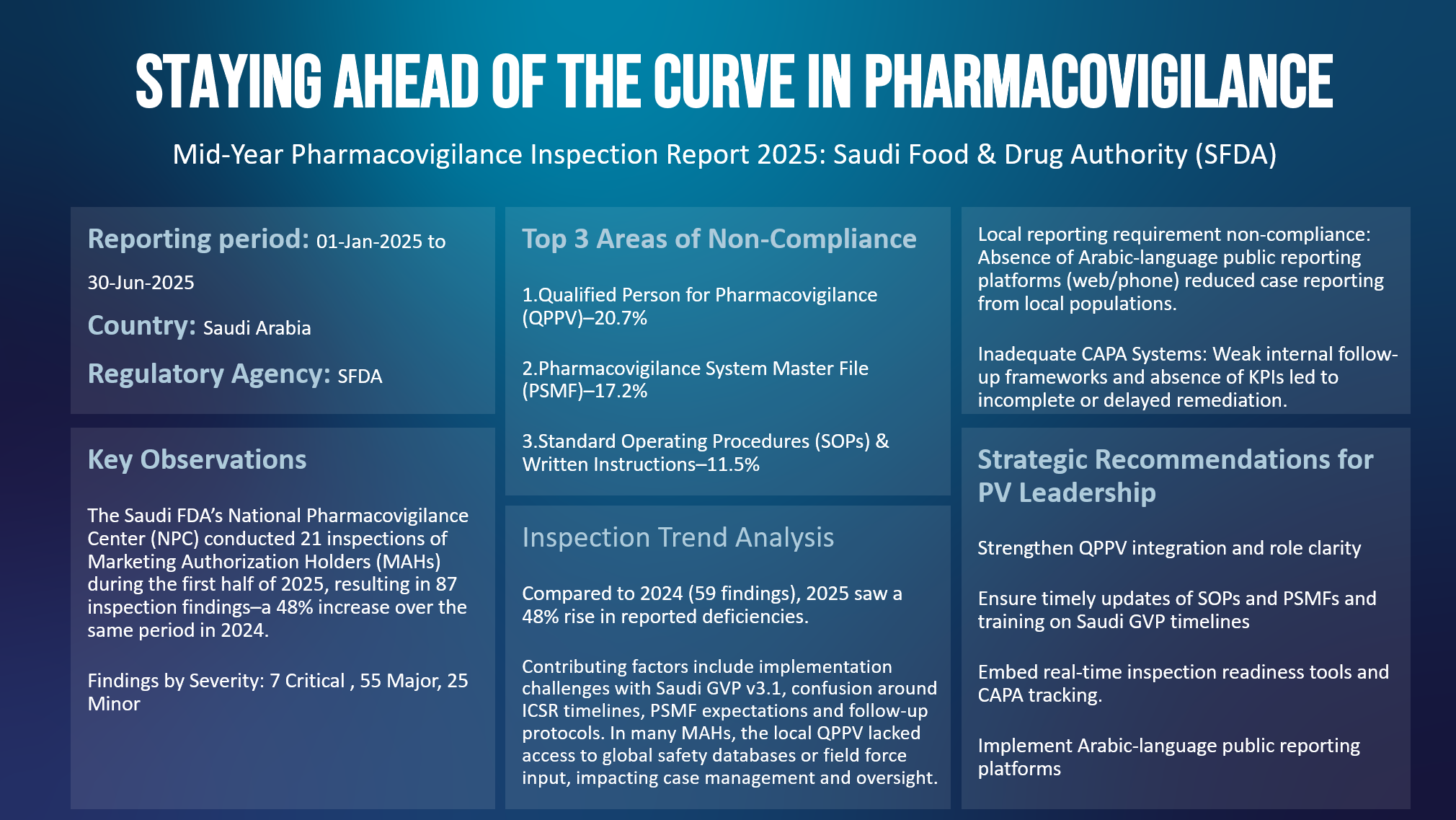
The Saudi FDA’s National Pharmacovigilance Center (NPC) conducted 21 inspections of Marketing Authorization Holders (MAHs) in the first half of 2025. These inspections revealed a significant uptick in compliance issues, with 87 findings—marking a 48% increase compared to the same period in 2024.
How were the findings categorized?
The 87 findings were broken down by severity:
- Critical: 7
- Major: 55
- Minor: 25
What were the most common areas of non-compliance?
The top three areas were:
- Qualified Person for Pharmacovigilance (QPPV): 20.7% of findings
- Pharmacovigilance System Master File (PSMF): 17.2%
- Standard Operating Procedures (SOPs) & Written Instructions: 11.5%
What challenges contributed to the rise in findings?
Several systemic and operational issues were identified:
- Implementation difficulties with Saudi GVP v3.1
- Confusion around Individual Case Safety Report (ICSR) timelines and follow-up protocols
- Lack of access for local QPPVs to global safety databases and field force insights
- Inadequate Corrective and Preventive Action (CAPA) systems and absence of KPIs
- No Arabic-language public reporting platforms, limiting local case submissions
What strategic actions are recommended for PV leaders?
To address these challenges, the report recommends:
- Strengthening QPPV integration and clarifying their responsibilities
- Updating SOPs and PSMFs in a timely manner and ensuring staff are trained on Saudi GVP timelines
- Implementing real-time inspection readiness tools and CAPA tracking systems
- Launching Arabic-language public reporting platforms to improve local engagement
Author

Dr. Narayan Tripathi is a seasoned and performance-driven healthcare professional with over 16 years of experience in Pharmacovigilance (PV). Currently serving as Senior Director of Pharmacovigilance at EVERSANA, he leads a team of over…